If you have ever scrolled through your Instagram feed and seen a “Buy Now” ad for a pair of sneakers, you have witnessed a performance marketing strategy in action. Conversely, if you feel a sense of trust when you see the Tata logo or a wave of nostalgia when the Amul girl appears on a billboard, you are experiencing the power of brand building. For years, the boardroom debate has been heated: Should we focus on immediate sales or long-term reputation?
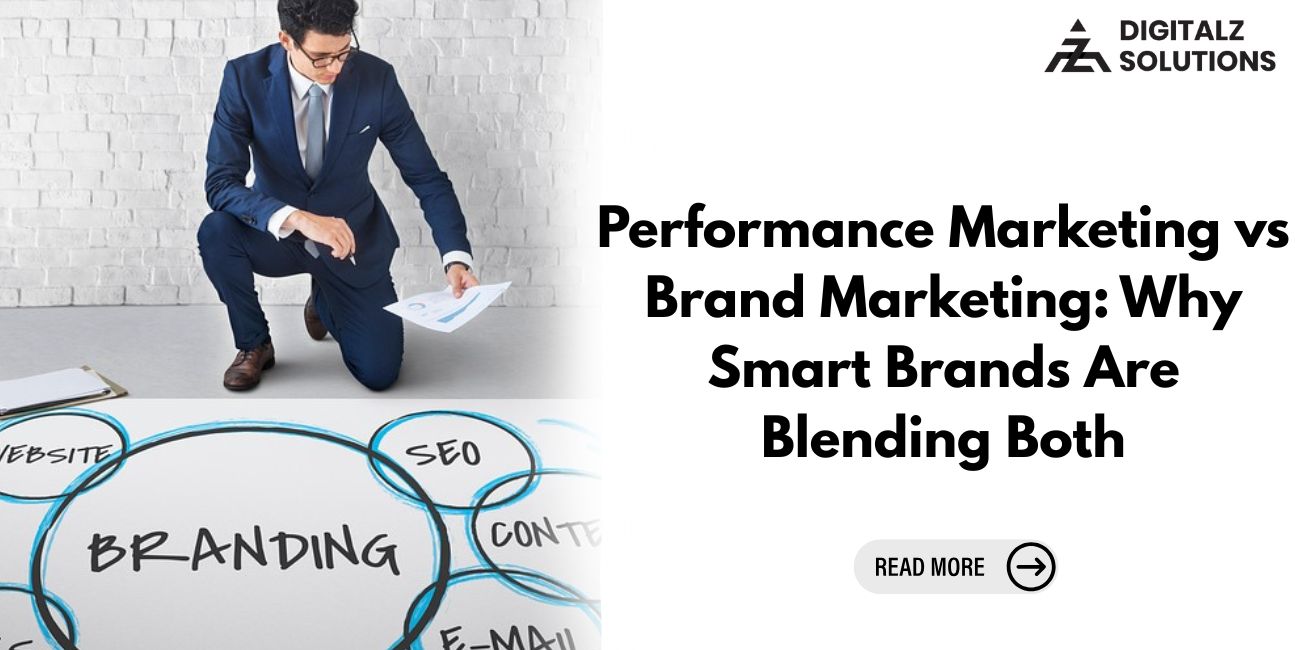
The truth is, the old-school division is dying. In the competitive Indian market of 2026, the real winners are not choosing one over the other. Instead, they are mastering the integration of Performance Marketing vs Brand Marketing to create a sustainable growth engine.
The Great Debate: Performance Marketing vs Brand Marketing
To understand why a blend is necessary, we must first look at what each side brings to the table. Performance Marketing vs Brand Marketing is often framed as “Short-term Wins” vs. “Long-term Wealth.”
Performance-based marketing is all about the “Now.” It is a conversion-focused marketing approach where every rupee spent is tied to a specific action, such as a click, a lead, or a sale. If you are a working professional in Mumbai or Bengaluru, you likely interact with these daily through Google Search or LinkedIn ads. It is highly efficient and provides that hit of dopamine when the ROI numbers look green.
On the other hand, brand marketing is the “Always.” It is about storytelling, values, and emotional resonance. It ensures that when a customer is ready to buy, your name is the first one they remember. Without a brand, your digital performance marketing efforts are essentially “renting” customers. With a brand, you “own” them.
Why Performance Marketing Needs a Soul
Have you ever noticed that even the most aggressive ROI-driven marketing campaigns eventually hit a wall? This is known as the performance plateau. You keep increasing your budget, but your cost-per-acquisition (CPA) starts to climb while your returns stay flat.
This happens because you have exhausted the “low-hanging fruit”—the people already looking for your product. To grow further, you need to reach people who don’t know they need you yet. This is where the synergy of Performance Marketing vs Brand Marketing becomes your secret weapon.
When people recognize and trust your brand, they are significantly more likely to click on your ads. Data from 2025 and 2026 shows that high-awareness brands in India achieve nearly 3 times higher conversion rates in their PPC advertising strategy compared to unknown labels. Brand equity acts as a lubricant for your performance engine, making every click cheaper and every conversion faster.
The Indian Context: Trust as a Currency
For the Indian consumer, trust is everything. Whether it is a Gen Z professional in a tech hub or a millennial manager in a Tier-2 city, the skepticism toward unknown digital entities is high.
Take the example of Zomato. Their Performance Marketing vs Brand Marketing balance is legendary. Their performance side handles hyperlocal notifications like “Hungry? Order Biryani now!” while their brand side wins hearts with witty tweets and relatable outdoor billboards. If Zomato only did ads, we would find them annoying. Because they have a “personality,” we find them helpful.
Key Differences at a Glance
| Feature | Performance Marketing | Brand Marketing |
| Primary Goal | Immediate Conversions | Long-term Loyalty |
| Focus | Product Features & Offers | Values & Storytelling |
| Metrics | CPA, ROAS, CPC | Awareness, Sentiment, Recall |
| Timeframe | Short-term (Days/Weeks) | Long-term (Months/Years) |
Export to Sheets
Finding the Magic Ratio: The 60/40 Rule
One of the most frequent questions we get at atozdigitalz.com is: “How much should I spend on each?”
While every business is unique, the legendary “Long and Short of It” research suggests a 60/40 split. This means allocating 60% of your budget to brand-building and 40% to lead generation marketing. This ratio ensures you are planting seeds for the future while harvesting the crops of today.
If you lean too heavily into a Performance Marketing vs Brand Marketing battle where performance wins 100% of the budget, your brand will eventually become a commodity, forced to compete only on price. Is that a race you want to win? Probably not.
How to Blend Performance Marketing vs Brand Marketing Effectively
So, how do you actually execute this blend without wasting your budget? Here are some actionable tips for marketing professionals:
- Use Brand Assets in Performance Ads: Don’t just show a product with a “50% Off” sticker. Use your brand’s unique voice and visual style in your measurable marketing campaigns.
- Retargeting with a Story: If someone visits your site through a cost-per-click (CPC) marketing ad but doesn’t buy, don’t just show them the same product again. Show them a video about your company’s mission or a customer testimonial to build trust.
- Measure the “Full Funnel”: Stop looking at your ads in isolation. Use multi-touch attribution to see how a brand awareness video on YouTube might have assisted a final conversion on Google Search.
The Role of AI in 2026
We cannot talk about Performance Marketing vs Brand Marketing in 2026 without mentioning AI. Tools like Google’s Gemini and advanced machine learning are now doing the heavy lifting for bidding and targeting.
This shift means that “human” creativity is actually more important than ever. Since AI can optimize the cost-per-acquisition (CPA) marketing logistics, your job is to provide the creative “hooks” and emotional stories that the AI can then distribute. The “smart” brands are those using AI to free up time for deeper brand strategy.
Common Pitfalls to Avoid
In our experience at atozdigitalz.com, we see two big mistakes:
- The “Performance Only” Trap: Startups often do this to show quick results to investors, only to realize two years later that no one actually cares about their brand name.
- The “Vague Branding” Trap: Spending lakhs on a beautiful video that has no clear call-to-action or link to the actual product.
The goal of Performance Marketing vs Brand Marketing is not to choose a side but to make them talk to each other. Your brand should make your ads work harder, and your ads should give your brand more visibility.
Practical Tips for Success
- Audit Your Messaging: Does your “Buy Now” ad sound like it belongs to the same company as your “About Us” page? Consistency is key to building trust.
- Focus on LTV, not just CAC: Calculate the Lifetime Value of your customers. Brand-loyal customers usually have a much higher LTV than those who bought once because of a discount.
- Test and Learn: Use A/B testing to see if adding a “Brand Story” element to your landing page improves your conversion rates.
Conclusion: The Unified Path Forward
The conflict of Performance Marketing vs Brand Marketing is a false choice. In 2026, marketing is a unified discipline. Performance gives you the data to understand what works, while branding gives you the permission to keep showing up in the customer’s life.
Smart brands realize that every performance ad is a brand touchpoint, and every brand campaign should eventually drive performance. By blending the two, you create a marketing ecosystem that is both efficient today and resilient tomorrow.
Are you ready to stop choosing and start blending? At atozdigitalz.com, we specialize in creating integrated strategies that deliver both the “clicks” and the “culture.”
Call now to schedule a consultation and let us help you build a brand that doesn’t just perform—it inspires.